

February Views
AI fakes, and a psychological theory of co-creation.
Back before Christmas, I found myself in a nearby neighbourhood with some time to browse a toy store. I knew of one shop nearby, but their remaining Lego inventory was a bit light, so I went searching for others nearby. Typing “toy store” into my Google Maps app, I found four new-to-me toy stores.
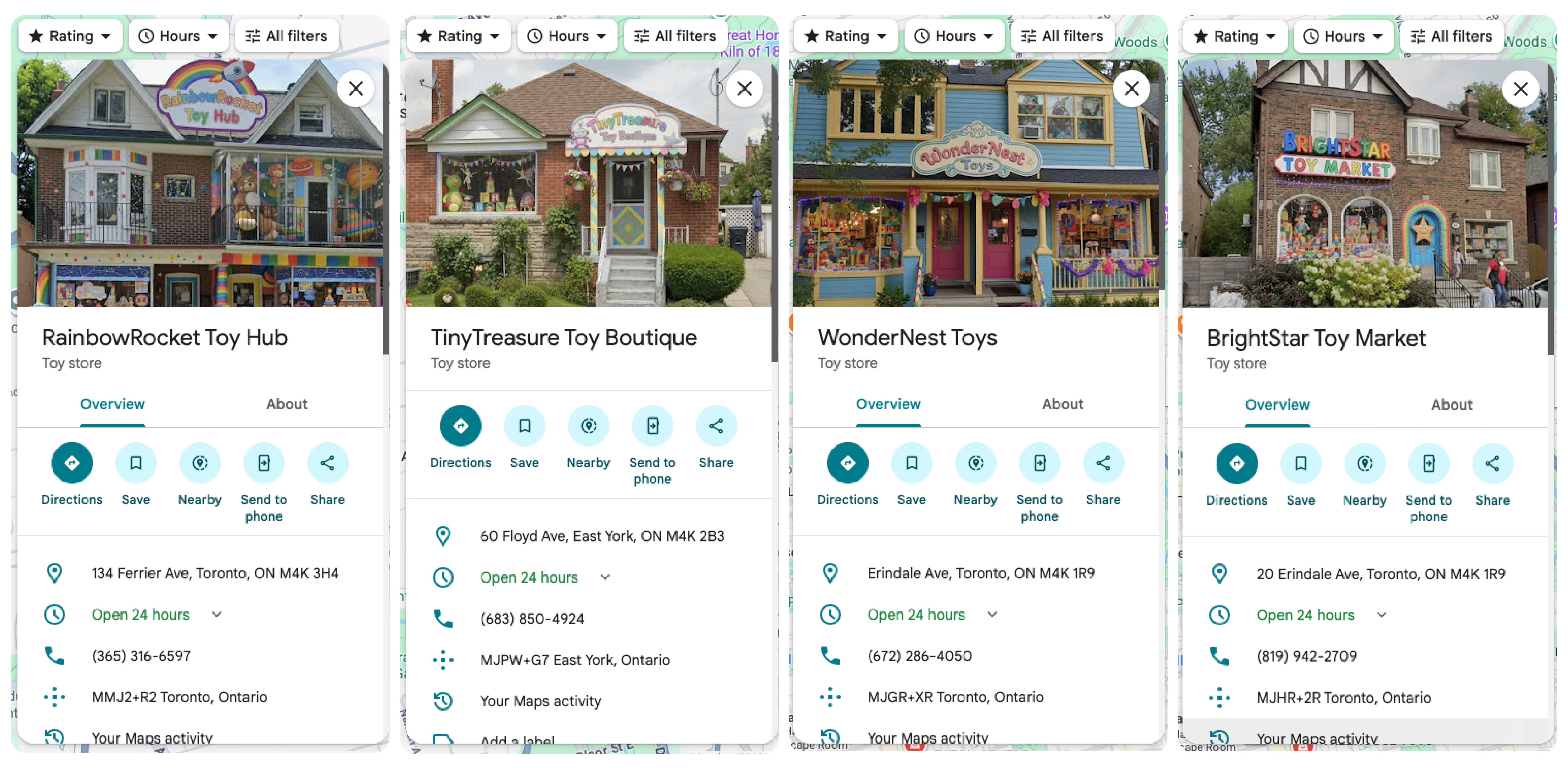
Of course, these are not real toy stores. They are AI-generated images superimposed on Google streetview. If you go to these addresses, you’ll find they’re all just regular houses.
I don’t know the specific grift here. Presumably, no one is trying to lure bricks-and-mortar shoppers to non-existent retail stores… these fake toy store listings must be meant to buttress a scam on some social media platform. They are obvious fakes if you know the neighbourhood, but if you were looking up just one store to verify what you saw elsewhere, it might be good enough.
That was December. Since then, I have seen a steady stream of stories about all the ways AI fakes are costing us time and money.
Made-up sob stories tugging our heart strings so we will overpay for generic, mass-produced goods.
Fake AI-generated reviews drowning out real human perspectives.
Even death offers no reprieve, with AI-generated obituaries targeting the bereaved to generate revenue from memorial flowers and candles.
The Internet has always been a place where nobody knows you’re a dog, with a fair share of unreliable information. But also, most of what you found on the Internet was authentic. Perhaps not always accurate, but mostly real people sharing what they really believe. Through sheer volume, LLMs are changing that. In more and more domains, the preponderance of information is AI-generated fakes. It’s increasingly hard to find the real human signal amidst all the AI noise.
If this was just about the Internet as a channel, I could be sanguine about it. But online information is so completely integrated into our lives, I worry we are losing the very ideas of reliability and trust.
We navigate the world (online and physical) with a strong default assumption of truthfulness and accuracy. Most people are mostly honest. Historically, publishing information required a fair amount of effort from multiple people. If you saw something written somewhere, it was probably reliable.
The AIs are changing the priors. When a small number of individuals with nefarious motives can effortlessly publish infinite fakes, it becomes foolish to default to trust. Instead, we start to default to doubt — a constant state of high-alert, skeptical about everything, forever asking, “Is this real? Is it trying to trick me?” Norms around honesty and truthfulness break down. Cynicism is the only rational response. And in our hyperconnected world, that won’t be an online-only phenomenon. Cynicism will be just as pervasive as the technology that demands it.
We’re not there quite yet. But I think we are underestimating the risk inherent in all the AI-generated fakery. It’s not just the time and the money, the added search costs and the petty grift. It’s the erosion of trust in society at large.
“Dishonest dealings tend to drive honest dealings out of the market,” wrote economist George Akerlof back in 1970. His model predicts that misrepresentation leads to total market collapse. When people can’t discern reliable from unreliable, they stop consuming. If there are no more consumers, it becomes pointless to produce. Soon, the only thing left is AI-generated chimera.
You don’t know what you’ve got ‘til it’s gone. Our economy and our society run on trust and reliability. By letting AI run amok, we are in the process of undermining those things. If we’re not careful, we’ll destroy them altogether. And once they’re gone, I don’t know how we’ll get them back.
Co-creation and Construal Level Theory: Helping stakeholders think about the details
There’s a famous New Yorker cover called the View of the World from 9th Avenue. It shows a couple of blocks of Manhattan in exquisite detail, but as we look further into the distance, the world becomes increasingly fuzzy and abstract.
The illustration is a commentary on how New Yorkers view themselves as the centre of the universe, but it *also* captures a psychological phenomenon called Construal Level Theory, or CLT. In its most simple form, CLT says that our brains, as a sort of shortcut, remove most of the details from our mental images for anything that feels distant or remote.
Remoteness can be a function of geographic distance, but it can equally be something that is happening a long time from now (vs. imminently), to some unknown individual (vs. to you or someone you know personally), or hypothetically (vs. certainly). Typically, all these dimensions go together. So, if something is geographically distant, then it also feels somehow more hypothetical, more impersonal, further into the future. And we maintain an abstract, light-on-detail construal of that idea, until such a time as it feels closer, more immediate, more certain, or more personal. Only then does our mental model become much more concrete and detailed.
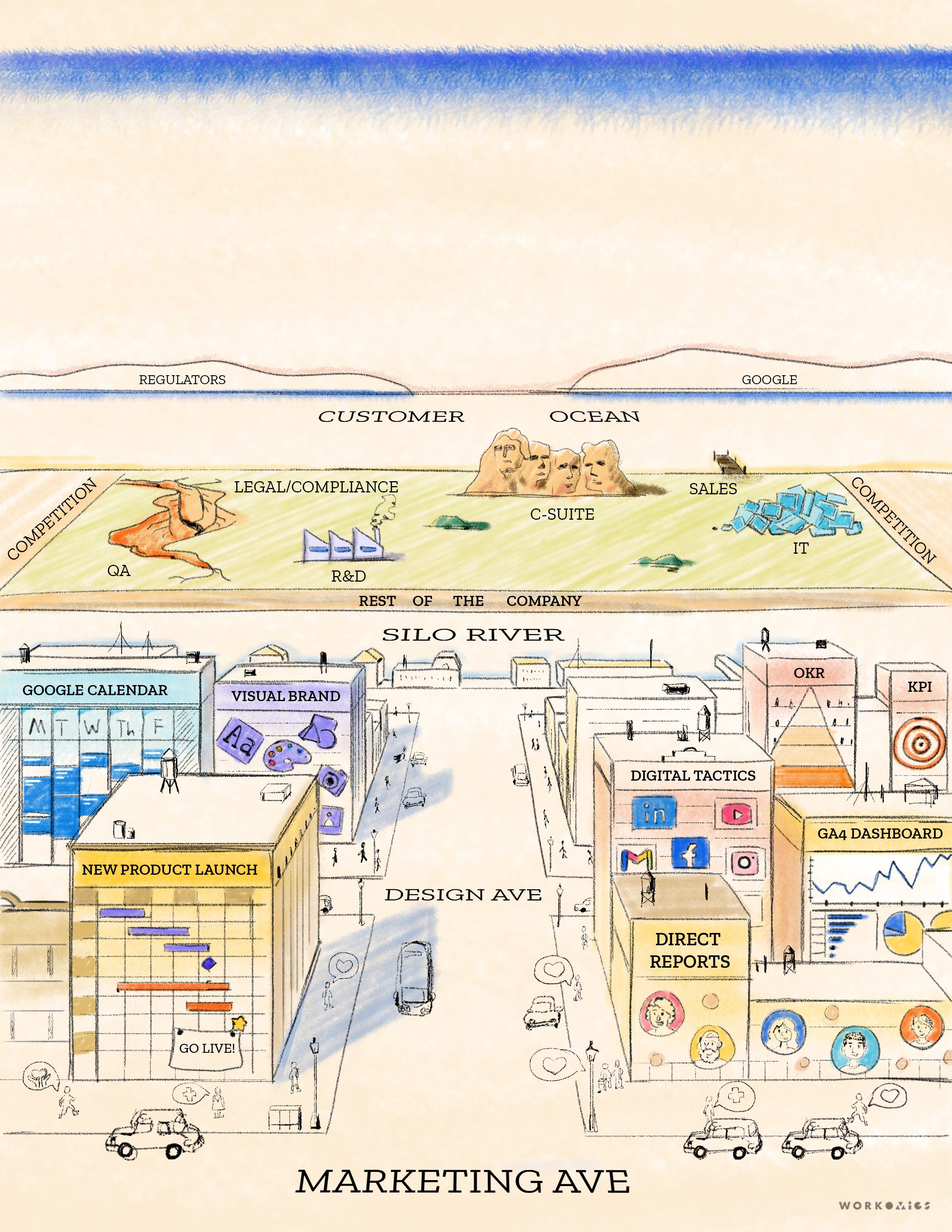
CLT explains why stakeholdering is so hard
CLT has important implications for stakeholdering and change management in organizations. Imagine you are trying to get buy-in for an initiative. Step one: gather your stakeholders and fire up PowerPoint. By its nature, a slide deck is an abstract representation of your initiative, so it will automatically make your initiative feel far away, impersonal, hypothetical.
No matter how many concrete details you share, CLT suggests that people will not keep those details in their mental model of your initiative. Instead, stakeholders will retain a few key features — whichever ones feel the most relevant to them personally. It’s not that they don’t care about those details. (Often they will have very! strong! views!) It’s that those details are just not currently in their understanding of what you just presented. It’s like a kind of detail blindness.
CLT further tells us that in this high-level state, people tend to be more optimistic — underestimating future difficulties1 — and more open to being swayed by others. CLT grimly predicts what will happen next: in the early meetings, everyone has a somewhat different, somewhat vague, overly-rosy picture of the project. Buy-in achieved!
But buy-in for what?
Some weeks or months later, you come back to the same stakeholders, this time sharing an imminent eventuality, rather than a distant possibility. Now, the details that were peripheral are very salient, and near-term worst-case thinking replaces long-term optimism. Buy-in dissipates.
It doesn’t matter that the details are not new and you shared them before. What matters is that your stakeholders now have a completely different mental model of the initiative — one that is much more concrete and detailed. It feels like you are back at square one, because you are — needing to re-enroll people in a whole new, far more detailed conception of the project.
Co-creation is a tool to shift stakeholders’ construal level
Co-creation can be a bit of a buzzword. Sometimes people use “co-creation” to mean seeking feedback from a group of customers (we might call that a focus group). Sometimes people use “co-creation” to mean engaging many customers to contribute ideas for a new thing (we might call that crowdsourcing).
When we use “co-creation”, we mean something very specific: engaging customers and internal stakeholders so that they are working with low-level, concrete construals, rather than high-level abstract ones. That is, bringing groups together to collaborate on something that feels concrete, immediate, personal, inevitable.
Staying high-level and abstract is a good way to get superficial buy-in. People aren’t thinking about the nitty-gritty details, so they more readily agree. But usually those same stakeholders realize they care (very much!) about the details as the go-live draws near. By staying high-level, you are only deferring hard conversations until you are further down the path and it’s more frustrating and more expensive to make changes.
For us, co-creation is a way to help everyone get to a lower-level construal sooner, so you can create more lasting alignment and buy-in. There is a natural human tendency towards abstraction. Especially in a team setting, it’s a very pro-social instinct: we build stronger social relationships when we focus on the generalities where we agree rather than the specifics where we don’t. However, when an organization sets out to build something new, it becomes counterproductive. Staying abstract prevents us from making the trade-offs that are inevitable as a project moves from something theoretical in the far future, to something real happening in the here-and-now.
In our co-creation work, we have found three ways to help participants stay engaged with the concrete details, so that we can achieve lasting buy-in on both the high-level initiative and the detailed trade-offs that will make it work in reality.
1. Shrink personal distance
Social distance is an important driver of construal level. When something affects you or someone you know, you are more likely to attend to the details. That shapes who we invite to the session. Bringing customers to the table helps an organization think about the details that will matter to users, rather than focusing on the back-of-house implementation details that might otherwise be top-of-mind. Bringing cross-functional stakeholders together helps surface important details from across the organization, which are unlikely to be uncovered by a more abstract slide presentation.
But removing social distance isn’t just about getting people into the same room — it’s also about how you structure time together. If a session feels overly formal and didactic, social distance stays high. The best co-creation sessions create a new social context where every individual feels like they belong and have equal standing to contribute. Practically, we achieve that through things like informal dress code (no suits!), round tables, and social time together over meals. We also dedicate meaningful time to introductions, and use warm-up games that help people get acquainted on a more personal level.
2. Facilitate for concrete details
Psychologists who do empirical research into CLT have uncovered a variety of conditions that prime people to develop either lower- or higher-level construals.
Words promote more abstract thinking, while pictures facilitate lower-level construals.
Familiarity promotes a lower construal level while something that feels new will seem more abstract and distant.
You can see and hear things that are quite far away, but can only touch things in arm’s reach, so tangibility promotes more detailed conceptions.
Sellers tend to have more abstract conceptions than buyers, so priming people with an end-user’s mindset will help them think more concretely.
All of these effects are subtle, but we carefully structure our co-creation facilitation to take advantage of these priming effects and help participants think more concretely about details. We introduce well-known ‘analogues,’ so people have a familiar reference point. Our biomedical communicators bring a lot of images and visuals into the session, and make quick sketches throughout discussions to make ideas more concrete. We use markers and chart paper to turn a conversation about a website into something people can touch.
CLT research strongly suggests that co-creation will be more effective in person, and that is our experience. However, even within a virtual setting, there are ways to help people be more concrete. We have shipped participants markers and notebooks and incorporated them into activities, to help bring tangible elements to a zoom call. Whether virtual or in-person, we ask customers to share their stories to help everyone adopt that perspective. We frame questions in user-centered terms, and use first-person language. (“I’m the patient and I’ve just landed on this website. What will I want to click first?”).
3. Co-create the right things
Because co-creation is an approach that is designed to get people thinking about the details, it will be most effective when you apply it to the right level of problem-solving. Co-creation is not great for answering “why” questions, figuring out what is desirable, or making decisions about big-picture trends. That kind of work benefits from more abstract thinking. To the extent we want to touch on some of these higher-level questions in a co-creation session, we will group them at the start or the end, so we can have a clear transition from abstract to concrete.
Co-creation is most valuable when we already know what we are creating and why, and it’s time to figure out how we will build it. What features will turn an average website into an excellent one? And what trade-offs will result in the best output? When people are thinking more abstractly, they tend to focus on one feature at the expense of all the others. (“Just give me whatever car will be the fastest”). When we get participants thinking about details in a co-creation setting, they get better at thinking about how those different features interact, and are better at weighing the relative value of competing attributes. (“All the fastest cars are the most expensive and don’t have the trunk space I need.”)
By shrinking personal distance, priming details, and focusing on the right things, co-creation makes important details salient long before they become barriers.
Co-creation is a powerful tool because it upends the normal way we share information inside an organization. We bring people together and provide thoughtful facilitation to help stakeholders think more concretely about important details they would otherwise struggle to conceptualize. Those details really matter — for implementation and for customers. By surfacing them while we are early in the development process, we have more options, and making changes is relatively painless.
Perhaps most importantly, the buy-in you build through co-creation is deeper and more lasting. Stakeholders who participated in co-creation leave the session feeling like the initiative is much more imminent. They see your initiative in the same vivid detail you do, rather than just a vague outline, somewhere out there in the indeterminate distance. And that, ultimately, translates into a shared motivation and sense of urgency, so you can work together to turn co-creation outputs into a reality.
End Notes

For the last couple of years, this final section has been a selection of interesting links we’ve shared around the Workomics crew. But recently, we’ve ramped up the company LinkedIn posting, so you can find all that content over there. For now, I’m going to try ending the newsletter with a bit more of a personal hodge-podge.
We took the kids to Ottawa for the Family Day long weekend, and had a great time outdoors at Winterlude and indoors at museums and such. We also spent lots of time visiting with old friends. Weekend trips are always tiring, in that you come back to a mountain of laundry, an empty fridge, and a full week. But to counterbalance, we had so much quality time with friends that the net effect of the adventure was actually energizing.
I decided to suspend normal morning responsibilities during the Olympics, so that we could spend the breakfast hour watching the action from Italy. Snowboard cross and short-track speed skating were particular favourites (alongside, of course, the curling). However, My 7-year old has issued strict instructions that we must never mention the men’s gold-medal hockey game EVER AGAIN.
This month I read Ann Patchet’s The Dutch House and Geraldine Brooks’s March, both of which were very good. I have also been reading Little Women aloud to the children. It’s a bit of a project due to the length, but both boys love it, and really identify with the struggles of the March girls. It was also fun to read Little Women and March simultaneously. In her afterword, Brooks says, “Nobody in real life is such a goody-goody as that Marmee.” I appreciated having March’s less goody-goody portrayal to counterbalance Alcott’s saintly mother, whose example I definitely cannot live up to!
Speaking of Marches….wishing you all a great one!
In comradeship,
S.
There is one CLT study I find particularly fascinating. The researchers asked participants to predict how they would perform on a hard test vs. an easy test. If the test was happening on the same day, people very consistently predicted they would do worse on the hard test. But if the test was two months away, people predicted they would perform the same on both the hard and easy test. The CLT interpretation is that “difficulty of the test” is a detail people just don’t consider for something in the distant future. But of course, in reality, it makes a significant difference!